EESTEC Event Presentations
The collaboration of the BCI Infrastructure and the local committee of the EESTEC volunteering group took for as an event which included both workshops and presentations in for of educational content. The presentations included high caliber speakers covering a large area of the field, from case studies, holistic overviews and venture capital insights.
We would like to officially thank Dr. Vincenzo Ronca, Prof. Anastasios Bezerianos and Dr. Demetres Iacovides for their time and effort they put into our event.
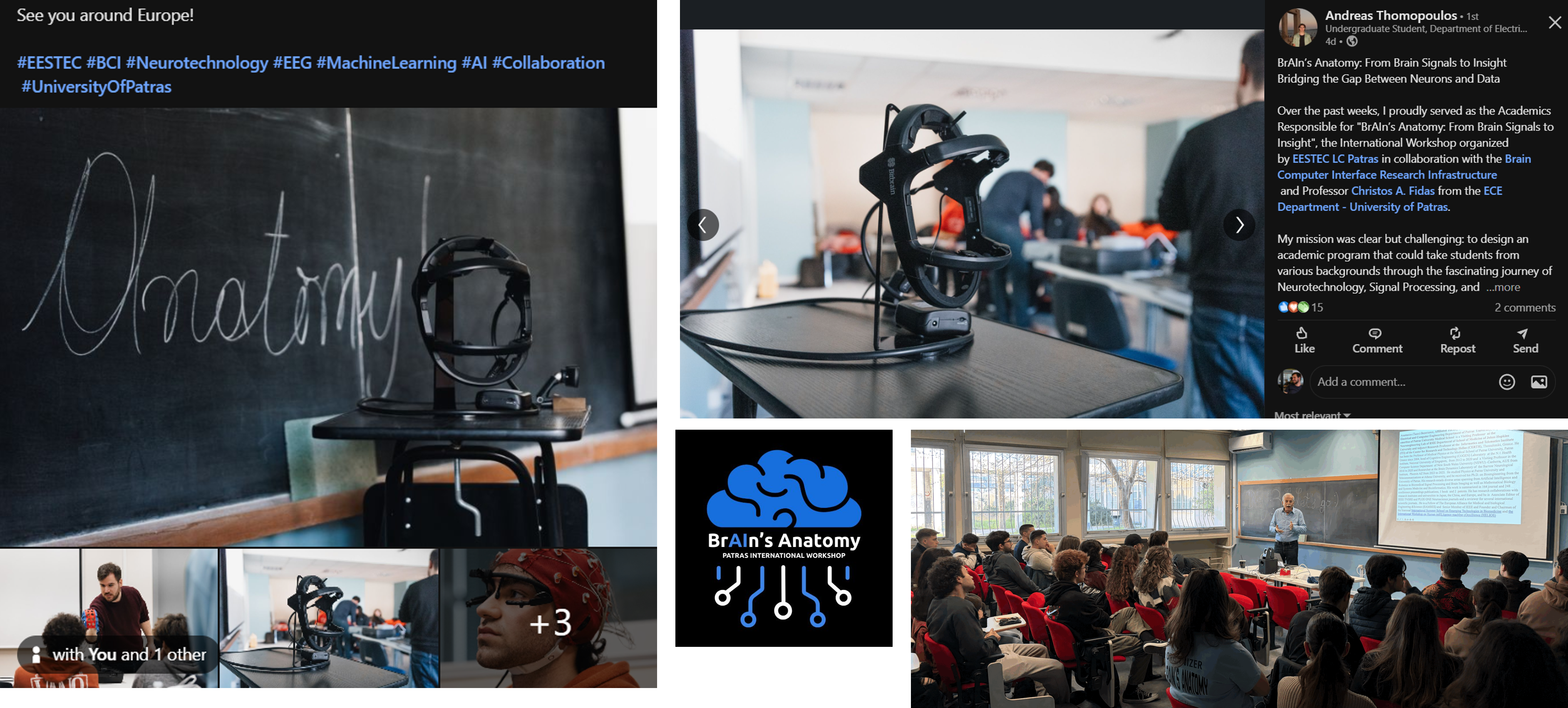
Presentations and Descriptions
"Passive Brain-Computer Interfaces Beyond the Lab: Neurophysiological Models for Safety-Critical Contexts"
Dr. Ronca's presentation can be downloaded as a pdf file by clicking here
Given by Dr. Ronca, it covers 4 case studies which were the result of the research in the La Sapienza University
Their presentation covered:
-
Brain-Computer Interfaces (BCIs)
BCIs decode brain activity to communicate with external systems. Passive BCIs monitor cognitive and emotional states without requiring user intent. -
Passive BCIs in Real-World Applications
Passive BCIs provide continuous monitoring of workload, stress, fatigue, and vigilance. They are particularly useful in safety-critical environments. -
Neurophysiological Signals and Human Factors
Signals such as EEG, EOG, ECG, and EDA provide objective measures of mental and physiological states. These metrics support real-time human performance assessment. -
Case Study: o-CLEAN EEG Artifact Removal
o-CLEAN is a real-time method for removing eye-blink artifacts from EEG recordings. It improves signal quality while preserving underlying neural activity. -
Case Study: MDrow Drowsiness Detection
MDrow is an EEG-based index for detecting driver drowsiness in real time. It outperforms traditional physiological measures in identifying short-term fatigue episodes. -
Case Study: Teamwork Assessment in Surgery
An EEG-based teamwork index measures neural synchrony between collaborators. Higher synchrony was associated with better team performance and expertise. -
Case Study: Cognitive Training Index (CTI)
CTI combines multiple EEG metrics into a single indicator of learning and skill acquisition. Results show that VR training can produce adaptations comparable to physical training. -
Conclusions and Future Directions
Passive BCIs are becoming practical tools for monitoring human performance outside the laboratory. Future work focuses on wearable systems, AI-enhanced analysis, and adaptive applications.
"Past, Present and Future of Neuroengineering"
This page covers:
- Principles of functional near-infrared spectroscopy
- Hemodynamic response and neurovascular coupling
- Optode placement and light penetration depth
- Signal characteristics and temporal resolution
- Common artifacts and noise sources
- Advantages and limitations of fNIRS measurements
Technology Commercialization and the Role of Venture Capital
Dr. Iacovides's presentation can be downloaded as a pdf file by clicking here.
In the presentation, it was discussed how the gap between invention of technologies such as BCI and their commercialization can be bridged by venture capital, by funding, validating and scaling early-stage innovations.
-
Overview
Many innovations fail to reach the market due to a gap between research and commercialization. Venture capital helps bridge this gap by enabling the transition from ideas to usable products. -
Role of Venture Capital
VC funds invest in early-stage startups in exchange for equity. They also provide strategic support, networks, and guidance to scale innovations. -
How Venture Capital Works
VC follows a power-law model where few successes generate most returns. Investments progress through stages (Seed to Series C) with structured evaluation and support. -
What VCs Look For
Investors prioritize strong IP, scalability, capable teams, and large markets. Clear milestones and exit opportunities are also essential. -
Investment Mechanics
Startup funding involves valuations, equity dilution, and investor protections. These determine ownership structure and returns across funding rounds. -
Case Study: Think Silicon
The company survived for years before VC validated its technology and enabled acquisition. It highlights persistence, the importance of networks, and VC as a catalyst. -
Why Startups Fail
Funding alone does not ensure success. Failures often result from poor economics, timing issues, or regulatory barriers. -
Conclusion
Commercializing technology is complex and uncertain. Success depends on the right mix of capital, team, timing, and persistence.